
How to Calculate Your Paycheck After Tax in 2026 (Federal Only)
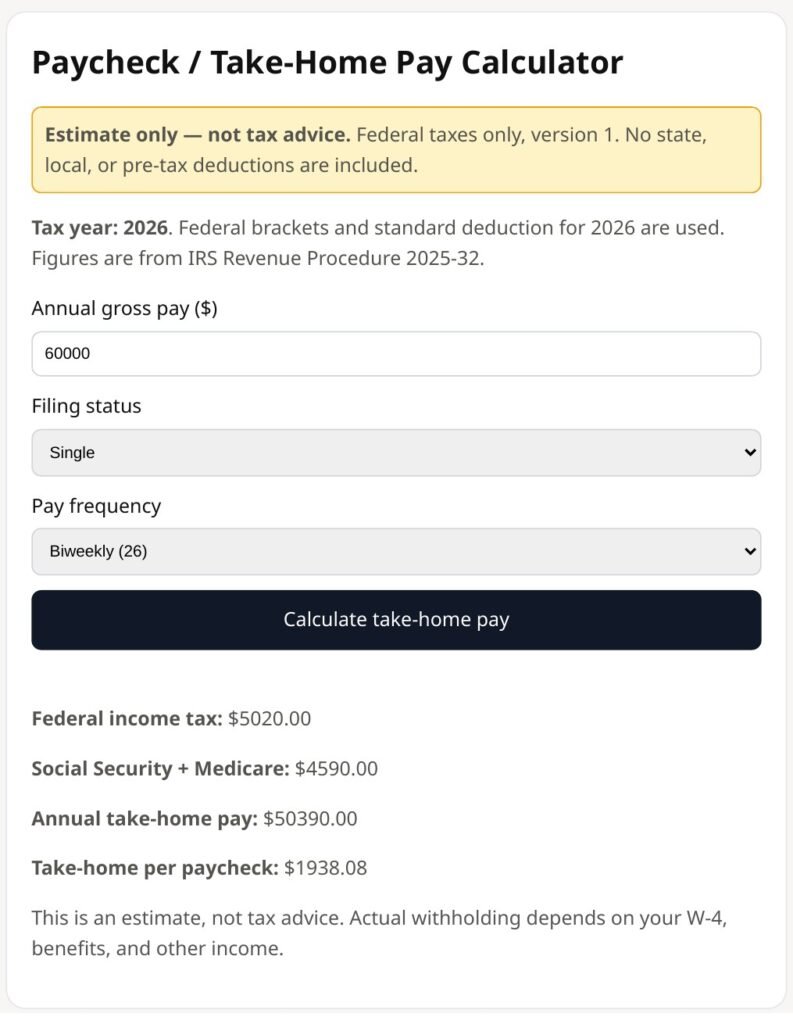
Quick answer: Take-home pay is your gross pay minus federal income tax, Social Security and Medicare. That is the whole calculation. On a $60,000 salary for a single filer in 2026, the federal income tax is $5,020 and the take-home pay is $50,390 a year. The free SavyTools Paycheck Calculator does this maths for you in your browser, for tax year 2026, with no sign up. It is federal tax only. This guide is an estimate only, not tax advice, and no figure here is exact withholding.
How to calculate your paycheck after tax in 4 steps
The formula fits on one line. Take-home pay equals gross pay minus federal income tax minus Social Security minus Medicare.
- Start with your annual gross pay. Use the full salary for the year, before any tax is taken out. The calculator takes annual gross pay only. If you are paid by the hour, work out your annual gross first and enter that.
- Subtract the standard deduction. This gives your taxable income. The 2026 standard deduction is $16,100 for a single filer, $32,200 for married filing jointly, and $24,150 for head of household.
- Run the taxable income through the federal brackets, slice by slice. Only the part of your income inside each bracket is taxed at that bracket rate. Your whole income is never taxed at your top rate.
- Subtract Social Security and Medicare, then divide by pay periods. Social Security is 6.2 percent of wages up to $184,500. Medicare is 1.45 percent of all wages, with no cap. Divide the annual take-home pay by 26 for a biweekly paycheck or by 12 for a monthly figure.
Summary. Annualise your pay, subtract the standard deduction, run the rest through the brackets slice by slice, then take off Social Security and Medicare. That is the method the calculator follows too.
2026 standard deduction
| Filing status | Standard deduction |
|---|---|
| Single | $16,100 |
| Married filing jointly | $32,200 |
| Head of household | $24,150 |
The standard deduction is the amount you subtract from your gross pay before any bracket applies. It is the same for everyone with the same filing status. The calculator does not ask your age, so it uses the basic standard deduction only.
2026 federal income tax brackets
The rates are unchanged from 2025. They are 10 percent, 12 percent, 22 percent, 24 percent, 32 percent, 35 percent and 37 percent. Only the thresholds moved. These brackets apply to taxable income, which is gross pay minus the standard deduction.
Single
| Rate | Taxable income |
|---|---|
| 10% | $0 to $12,400 |
| 12% | $12,400 to $50,400 |
| 22% | $50,400 to $105,700 |
| 24% | $105,700 to $201,775 |
| 32% | $201,775 to $256,225 |
| 35% | $256,225 to $640,600 |
| 37% | Over $640,600 |
Married filing jointly
| Rate | Taxable income |
|---|---|
| 10% | $0 to $24,800 |
| 12% | $24,800 to $100,800 |
| 22% | $100,800 to $211,400 |
| 24% | $211,400 to $403,550 |
| 32% | $403,550 to $512,450 |
| 35% | $512,450 to $768,700 |
| 37% | Over $768,700 |
Head of household
| Rate | Taxable income |
|---|---|
| 10% | $0 to $17,700 |
| 12% | $17,700 to $67,450 |
| 22% | $67,450 to $105,700 |
| 24% | $105,700 to $201,750 |
| 32% | $201,750 to $256,200 |
| 35% | $256,200 to $640,600 |
| 37% | Over $640,600 |
Figures are from IRS Revenue Procedure 2025-32. They apply to income earned in calendar 2026, reported on the return filed in early 2027.
Worked example 1: Single, $60,000 gross
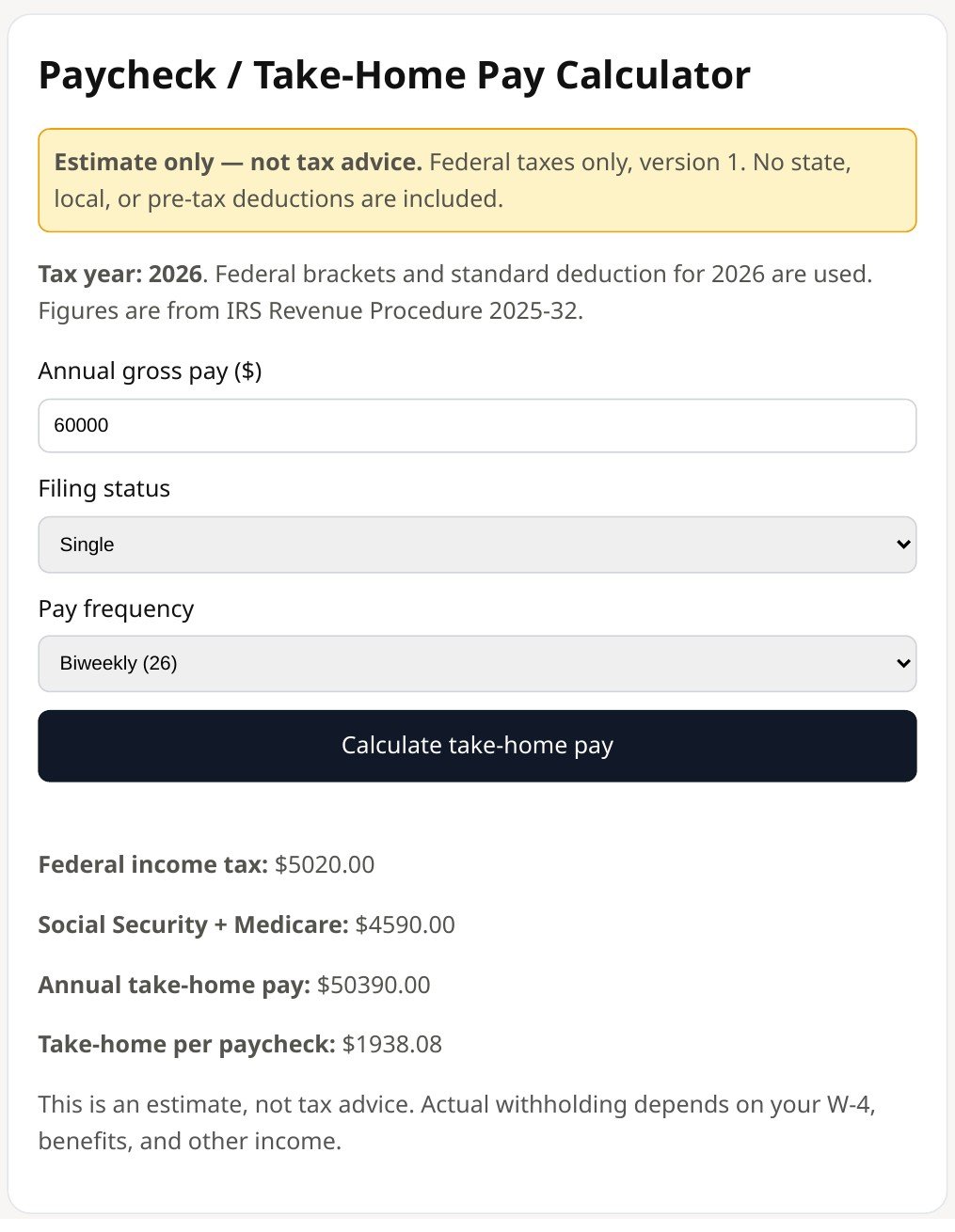
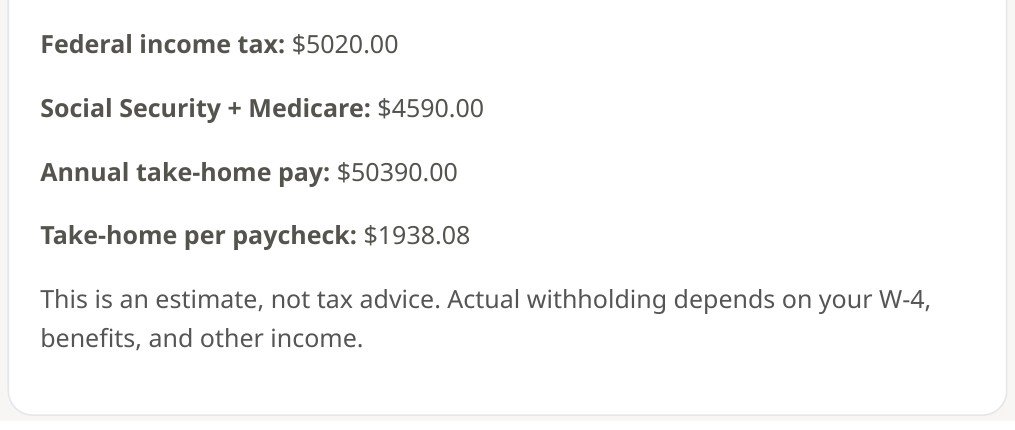
Gross pay $60,000 a year, single filer. Taxable income is $60,000 minus the $16,100 standard deduction, which is $43,900. The calculator shows the same result.
| Slice of taxable income | Amount taxed | Rate | Tax |
|---|---|---|---|
| $0 to $12,400 | $12,400 | 10% | $1,240 |
| $12,400 to $43,900 | $31,500 | 12% | $3,780 |
| Federal income tax | $5,020 |
Then the payroll taxes. Social Security is 6.2 percent of $60,000, which is $3,720. Medicare is 1.45 percent of $60,000, which is $870. Total tax is $5,020 plus $3,720 plus $870, which is $9,610. Take-home pay is $60,000 minus $9,610, which is $50,390 a year. That is $1,938.08 per biweekly paycheck (26 pays) and $4,199.17 per month.
Worked example 2: Married filing jointly, $100,000 gross
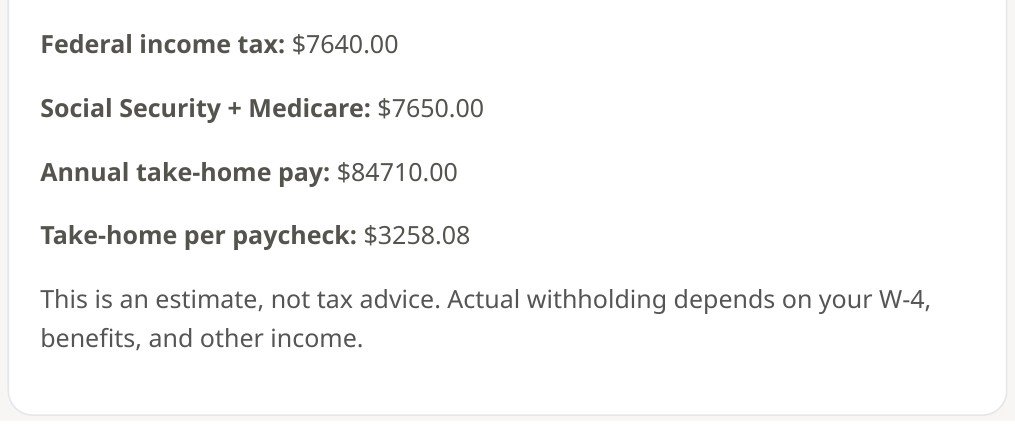
Gross pay $100,000 a year, married filing jointly. Taxable income is $100,000 minus the $32,200 standard deduction, which is $67,800. The calculator shows the same result.
| Slice of taxable income | Amount taxed | Rate | Tax |
|---|---|---|---|
| $0 to $24,800 | $24,800 | 10% | $2,480 |
| $24,800 to $67,800 | $43,000 | 12% | $5,160 |
| Federal income tax | $7,640 |
Then the payroll taxes. Social Security is 6.2 percent of $100,000, which is $6,200. Medicare is 1.45 percent of $100,000, which is $1,450. Total tax is $7,640 plus $6,200 plus $1,450, which is $15,290. Take-home pay is $100,000 minus $15,290, which is $84,710 a year. That is $3,258.08 per biweekly paycheck (26 pays) and $7,059.17 per month.
Worked example 3: Single, $75,000 gross
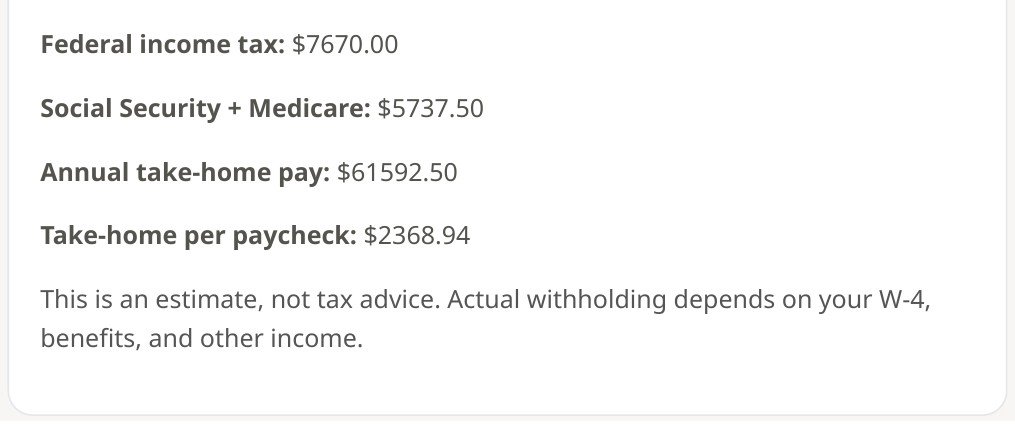
Gross pay $75,000 a year, single filer. Taxable income is $75,000 minus the $16,100 standard deduction, which is $58,900. This example reaches the 22 percent bracket, so it shows how a third slice works. The calculator shows the same result.
| Slice of taxable income | Amount taxed | Rate | Tax |
|---|---|---|---|
| $0 to $12,400 | $12,400 | 10% | $1,240 |
| $12,400 to $50,400 | $38,000 | 12% | $4,560 |
| $50,400 to $58,900 | $8,500 | 22% | $1,870 |
| Federal income tax | $7,670 |
Then the payroll taxes. Social Security is 6.2 percent of $75,000, which is $4,650. Medicare is 1.45 percent of $75,000, which is $1,087.50, shown as $1,088 rounded. Total tax is about $13,408. Take-home pay is about $61,593 a year. That is $2,368.94 per biweekly paycheck (26 pays).
Marginal rate vs effective rate
These two rates sound alike, but they are different numbers, and mixing them up is the most common mistake in paycheck maths. Use the $60,000 single example. Your marginal rate is the rate on your last dollar of income. For the $60,000 single filer, the top slice of taxable income sits in the 12 percent bracket, so the marginal rate is 12 percent. If this filer earned one more dollar, 12 cents of it would go to federal income tax. Your effective rate is the total federal tax divided by your gross pay. For the same filer, $5,020 divided by $60,000 is 8.4 percent. It is lower than the marginal rate because most of the income was taxed at 10 percent, and only the part above $12,400 was taxed at 12 percent.
| Figure | Amount |
|---|---|
| Gross pay | $60,000 |
| Federal income tax | $5,020 |
| Marginal rate (top bracket) | 12% |
| Effective federal rate | 8.4% |
Summary. The marginal rate tells you what the next dollar costs. The effective rate tells you what share of your whole pay went to federal tax. When someone says they are in the 22 percent bracket, that is their marginal rate, not the share they pay overall.
What the calculator leaves out
The Paycheck Calculator is federal tax only, version 1. Saying plainly what it does not do is part of using it right.
- No state or local tax. State income tax is a separate calculation and varies by state. This guide and the calculator cover federal tax only.
- No 401(k) or health premiums. The calculator does not take pre-tax deductions. If your employer takes 401(k) contributions or health premiums out of your pay before tax, your real taxable income is lower than the figure used here, and your real take-home pay will differ.
- No hourly pay, overtime or tips. The tool takes annual gross pay only. It does not cover hourly wages, overtime pay, tips, or the new tips and overtime deductions.
- Your payslip can differ. Your employer withholds tax following your W-4 and payroll schedule, so real withholding can differ from this estimate by a few dollars.
- Social Security stops at the wage base. Social Security is 6.2 percent of wages up to $184,500 in 2026. Above that wage base, no more Social Security is taken. The maximum employee Social Security tax for 2026 is $11,439.
- Additional Medicare Tax is not counted here. The tax code adds an extra 0.9 percent above $200,000 for a single filer or head of household, and above $250,000 for married filing jointly. The tool page does not say whether it applies this extra amount, so this guide does not count it.
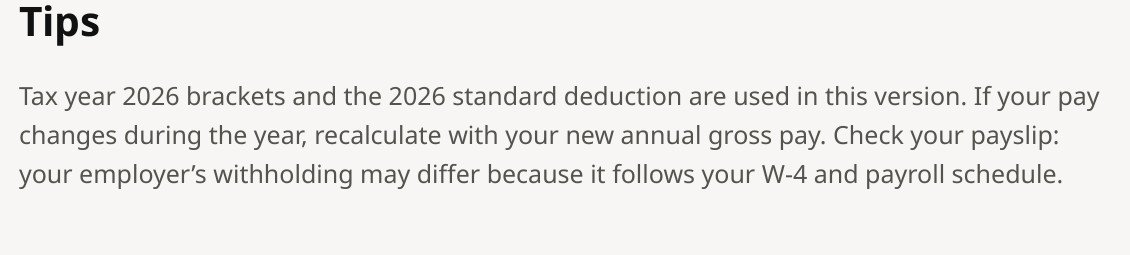
- If your pay changes during the year, recalculate. Enter your new annual gross pay and run the calculator again. Do not reuse an old result after a raise or a job change.
If you need to plan a loan against your take-home pay, the Loan Calculator works out a monthly loan payment, and the guide at https://savytools.com/how-to-calculate-a-loan-payment/ walks through the same $20,000 example. For a house budget, the Mortgage Calculator covers principal and interest only. The Paycheck Calculator itself is at https://savytools.com/paycheck-calculator/.
FAQ
Is this tax advice?
No. This guide is an estimate only, not tax advice. It shows how the federal calculation works and what the free calculator estimates. For advice about your own return, talk to a tax professional.
Which tax year does the calculator use?
Tax year 2026. The federal brackets and standard deduction for 2026 are used. The figures are from IRS Revenue Procedure 2025-32.
Does the calculator include state tax?
No. It is federal tax only. No state or local tax is included, and no state figure is estimated.
Does the calculator include Social Security and Medicare?
Yes. Social Security is 6.2 percent of wages up to the $184,500 wage base, and Medicare is 1.45 percent of all wages with no cap. The tool page does not say whether the extra 0.9 percent Additional Medicare Tax is applied, so this guide does not count it.
Why does my payslip show a different take-home pay?
Your employer withholds tax following your W-4 and payroll schedule, so real withholding can differ from this estimate by a few dollars. Pre-tax deductions such as 401(k) contributions and health premiums also change the result, and this calculator does not include them.
What if my pay changes during the year?
Recalculate with your new annual gross pay. Enter the new figure in the calculator and use the new result. Do not reuse an old result after a raise or a job change.
