
How to Calculate Percentage (Free Calculator + Formula)
Percentages show up everywhere — on sale tags, in your tip at dinner, on test scores, even in your paycheck. And yet, the moment someone asks you to work one out in your head, it can feel oddly tricky. The good news? Learning how to calculate a percentage takes about two minutes, and once the method clicks, you will use it for the rest of your life.
In this guide I will walk you through the one simple formula behind every percentage calculation, then show you how it works in the situations you actually run into: discounts, tips, test scores, and price increases. And if you just want the answer right now, you can skip the maths entirely and use SavyTools’ free Percentage Calculator — no sign up, no app, it runs right in your browser.
What Is a Percentage, Really?
The word “percent” literally means “out of one hundred.” So when someone says 25%, they mean 25 out of every 100. That is the whole idea. A percentage is just a way of describing a part of something as if that something were split into 100 equal pieces.
Think of it like this: if a pizza is cut into 100 tiny slices and you eat 25 of them, you have eaten 25% of the pizza. If you scored 90 out of 100 on a quiz, you got 90%.
The Percentage Formula (the Only One You Need)
Almost every percentage question you will ever meet boils down to one formula:
Percentage = (Part ÷ Whole) × 100
That is it. Divide the part you care about by the total, then multiply by 100. If you can do that, you can answer “what percent is this of that?” for anything — a test score, a discount, a survey result, a pay raise.
There is a second version you will use just as often, for finding a percentage of a number:
Value = (Percentage ÷ 100) × Total
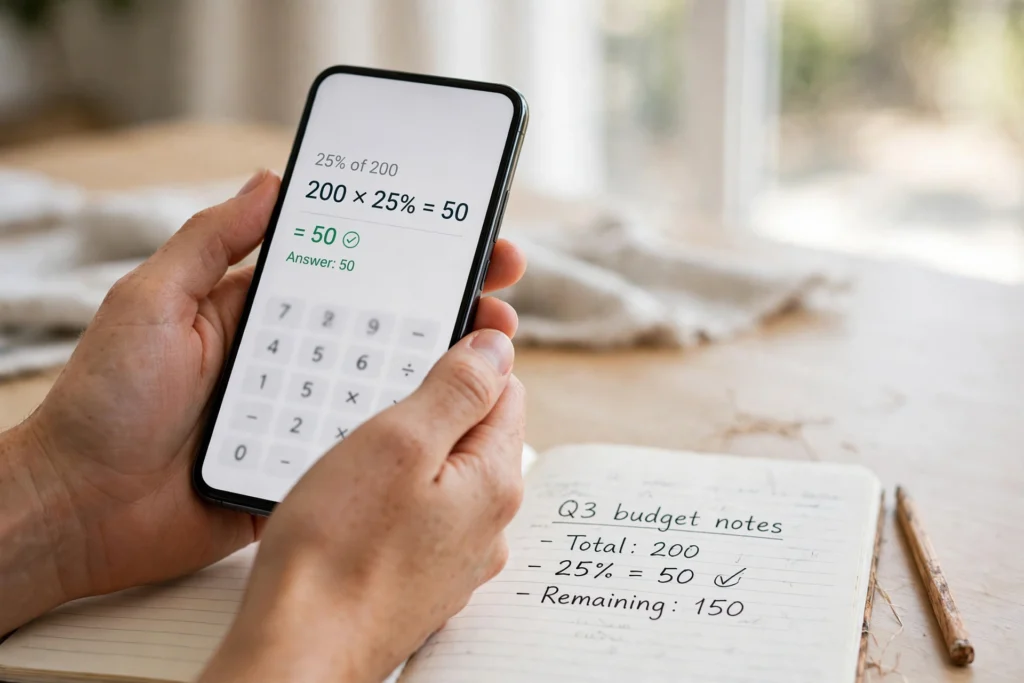
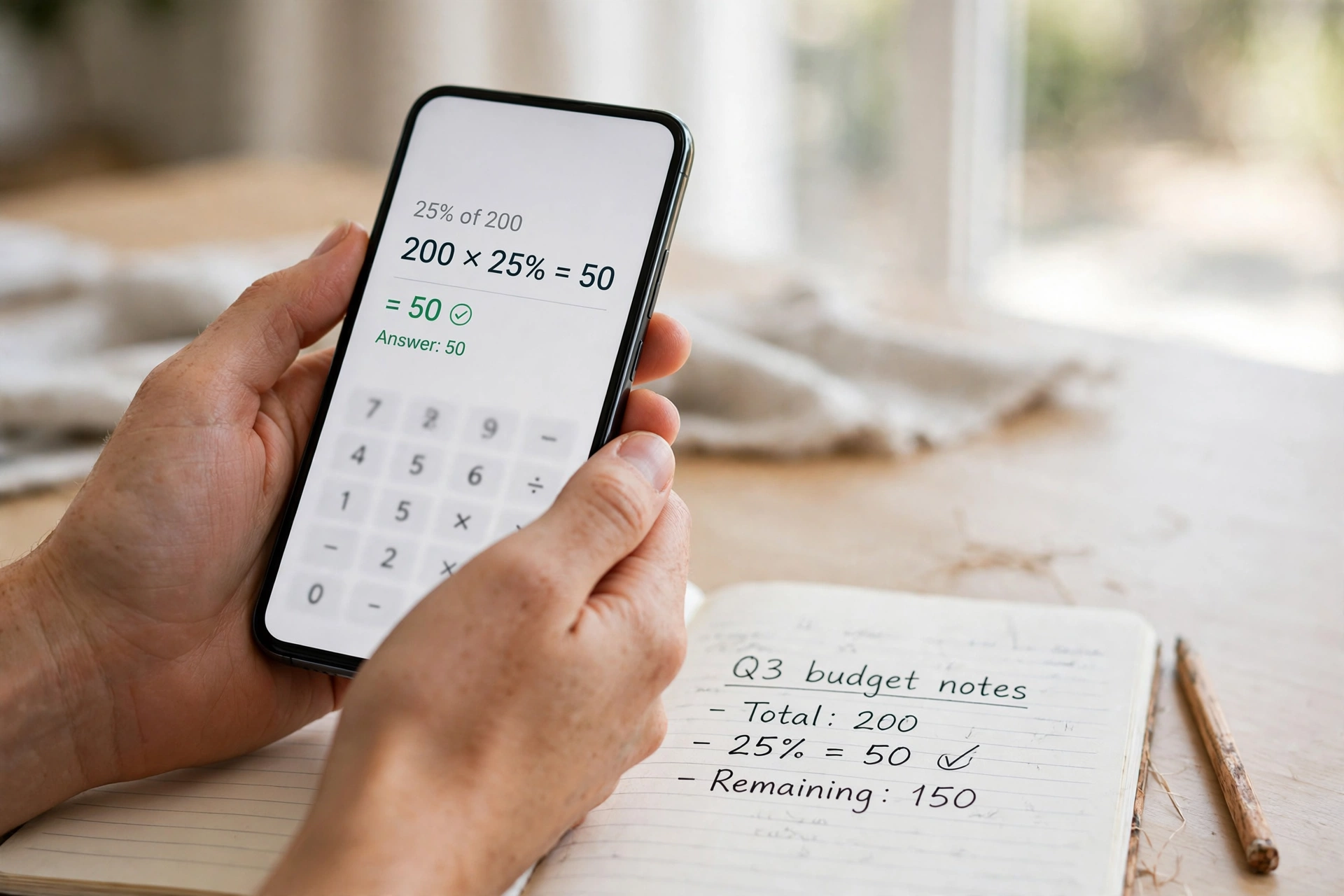
So 25% of 200 is (25 ÷ 100) × 200, which is 0.25 × 200 = 50. Keep these two formulas in your back pocket and you are set.
How to Calculate a Percentage in 3 Steps
Let us make this concrete. Say you got 18 out of 20 questions right on a quiz. What percentage is that?
- Divide the part by the whole. 18 ÷ 20 = 0.9.
- Multiply by 100. 0.9 × 100 = 90.
- Add the % sign. Your score is 90%.
That is the whole process, every time. Divide, multiply by 100, add the sign. The only thing that ever changes is which numbers you plug in.
How to Find the Percentage of a Number
This is the version you will use most in daily life — working out a tip, a tax amount, or a share of something. The question sounds like “what is 15% of 60?” and the trick is to turn the percentage into a decimal first.
Take 15% of a $60 dinner bill, for example. Move the decimal point two places to the left: 15% becomes 0.15. Then multiply: 0.15 × 60 = 9. Your tip is $9. Nice and simple.
Here are a few more you can check in your head:
- 10% of 250 = 25 (just move the decimal one place: 250 becomes 25)
- 20% of 80 = 16 (0.20 × 80)
- 25% of 200 = 50 (a quarter of 200)
A handy shortcut: 10% of any number is just that number with the decimal moved one place left. Once you know 10%, you can build almost any other percentage from it — 20% is double 10%, 5% is half of 10%, and 15% is 10% plus 5%. I use this trick constantly at restaurants, and it has never let me down.
How to Calculate a Discount Percentage
Sale season is where percentage skills pay for themselves — literally. Suppose a jacket costs $80 and it is 25% off. How much do you actually pay?

First, find the discount amount: 25% of 80. As a decimal, 25% is 0.25, and 0.25 × 80 = 20. So you save $20, and the jacket costs $80 − $20 = $60.
There is a quicker way, too. If 25% is coming off, you are paying the other 75%. So just calculate 75% of 80 directly: 0.75 × 80 = 60. Same answer, one step fewer. This “pay the rest” trick works for any sale — a 40% off deal means you pay 60% of the price.
And if you are standing in a store aisle doing this on your phone, honestly, just open the Percentage Calculator and type the numbers in. There is no prize for doing sale maths in your head while a queue forms behind you.
How to Calculate Percentage Increase
Price rises, pay raises, and rent hikes all use the same idea: how much did something change compared to where it started?
The formula is: Percentage increase = ((New value − Old value) ÷ Old value) × 100
Here is a real example. Your streaming subscription goes from $12 a month to $15 a month. The increase is $15 − $12 = $3. Divide that by the old price: 3 ÷ 12 = 0.25. Multiply by 100 and you get a 25% increase. That “only $3 more” suddenly sounds a lot bigger, does it not?
The same formula handles decreases, too — if the result is negative, it is a percentage decrease. A $50 item dropping to $40 is (40 − 50) ÷ 50 × 100 = −20%, a 20% drop.
How to Calculate Your Test Score as a Percentage
Students ask this one constantly: “I got 45 out of 50 — what is my percentage?” It is the same divide-and-multiply routine, and it works for any total, not just 100.
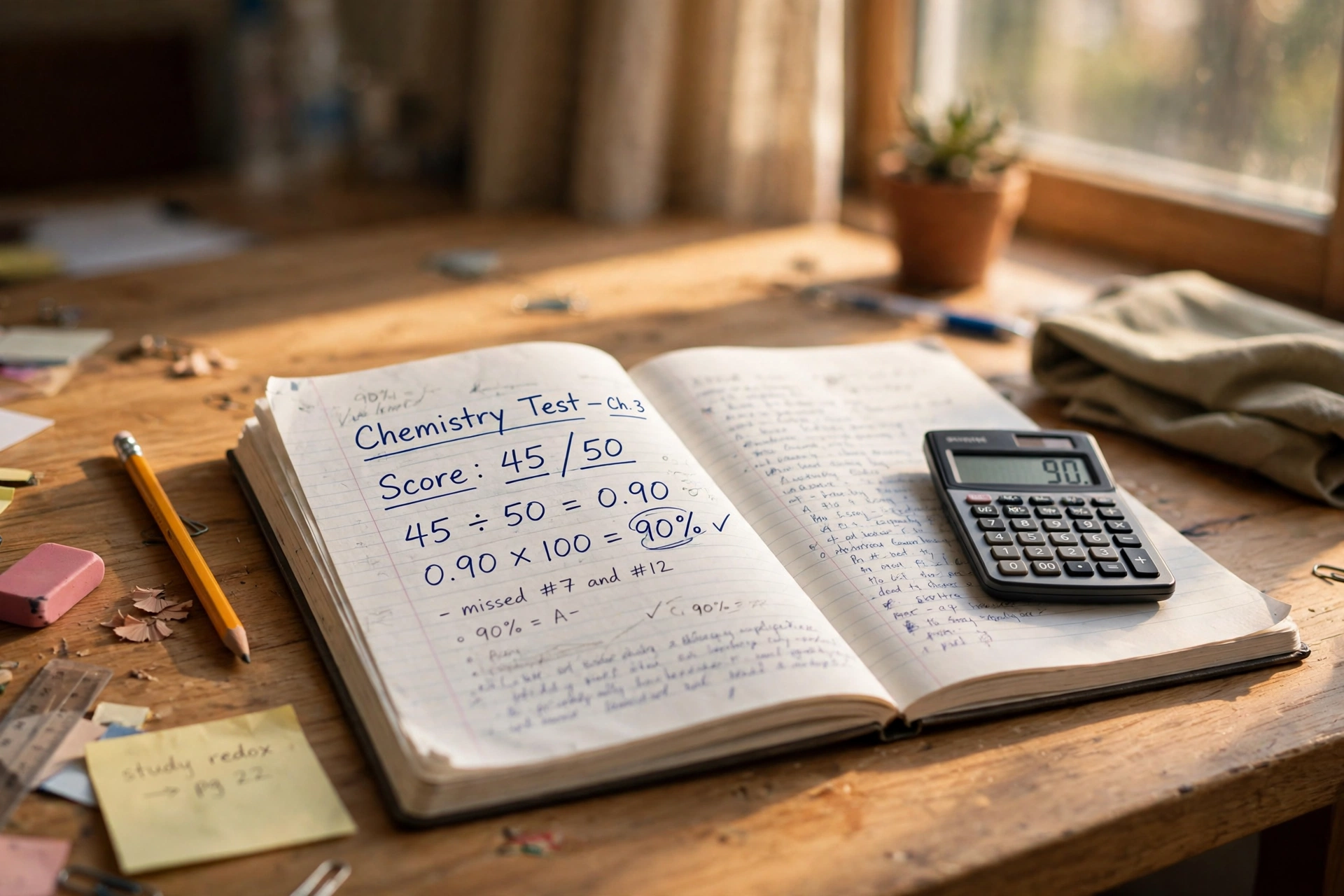
Divide your score by the total: 45 ÷ 50 = 0.9. Multiply by 100 and you get 90%. If your school grades on the usual US scale, 90% is normally an A−, so that is a result worth celebrating.
A few more quick conversions for the most common test totals:
- 17 out of 20 = 85%
- 38 out of 40 = 95%
- 72 out of 80 = 90%
- 27 out of 30 = 90%
If you are tracking your grades across a semester, this is also where a tool like our GPA Calculator comes in handy — it turns those percentages into the GPA colleges actually look at.
Common Percentage Mistakes to Avoid
Percentages are simple, but three mistakes trip people up again and again:
Adding percentages that do not share the same base. A 20% discount followed by another 10% off does not equal 30% off. The second discount applies to the already-reduced price, so you actually save 28% in total.
Forgetting to convert the percentage to a decimal. Multiplying 25 × 200 instead of 0.25 × 200 gives you 5,000 — an answer that is off by a factor of 100. Always divide the percentage by 100 first.
Mixing up “percent of” and “percent increase.” Going from 50 to 75 is a 50% increase, but 75 is 150% of 50. Same numbers, very different meanings. Check which question you are actually answering before you start dividing.
Frequently Asked Questions
How do I calculate percentage increase?
Subtract the old value from the new value, divide the result by the old value, and multiply by 100. For example, a price rising from $40 to $50 is (50 − 40) ÷ 40 × 100 = 25% increase.
What is the easiest way to find the percentage of a number?
Turn the percentage into a decimal by moving the decimal point two places left, then multiply. For 15% of 60, use 0.15 × 60 = 9. Or find 10% first (move the decimal one place) and build from there — 20% is double 10%, 5% is half of 10%.
How do I calculate the percentage of my marks?
Divide the marks you scored by the total marks, then multiply by 100. If you scored 45 out of 50, that is 45 ÷ 50 × 100 = 90%. This works for any total, whether the test was out of 20, 50, or 100.
The Bottom Line
Every percentage problem is the same move in disguise: divide the part by the whole and multiply by 100 — or turn the percentage into a decimal and multiply. Learn that, plus the 10% shortcut, and you can handle discounts, tips, grades, and price rises without breaking a sweat.
And on the days when your brain is tired or the numbers are ugly, there is no shame in letting a tool do it. Our free Percentage Calculator handles all of it — percentages of numbers, increases, decreases, and discounts — in seconds, with no sign up. If you are planning a bigger purchase, our guide on how to calculate a loan payment is a natural next read.
