How Much House Can I Afford? (2026 Guide)

Figuring out how much house you can afford is the least glamorous part of house hunting — and the most important. It is also the part most people do backwards. They fall in love with a house first, then try to stretch the budget to fit it. I have watched friends do exactly that, and the result is almost always the same: a beautiful kitchen, and a monthly payment that quietly eats their weekends, their savings, and their sleep.
Here is a calmer way: work out what monthly payment feels comfortable, then work backwards to a house price. A free calculator, a few honest numbers, and ten minutes will get you a realistic range.

Start With the Monthly Payment, Not the Price Tag
A $400,000 house sounds like a single number. It is not. What you actually live with is a monthly payment, month after month, for years. That payment depends on your down payment, your interest rate, and whether you choose a 15-year or a 30-year loan. Change one of those, and the same house can feel easy or impossible.
Lenders do not start with the house. They start with your income and your debts — and you should too. Before browsing another listing, sit down with your take-home pay, car payment, student loans, and credit card minimums.
Take a couple in Ohio earning $90,000 combined: a $380,000 house looked fine until taxes, insurance, and a forgotten car payment added nearly $500 a month. They bought at $315,000 instead — and still travel, save, and like their house.
The 28/36 Rule, Explained in Plain English
If you search for affordability advice, you will keep meeting the 28/36 rule. It sounds technical. It is not. It is just two guardrails many US lenders use as a starting point. First, try to keep your total housing costs — mortgage, taxes, insurance, and HOA dues — at or below 28% of your gross monthly income. Second, try to keep all your monthly debt payments, housing included, at or below 36% of gross monthly income.
Gross means before tax, so if 28% already feels tight on paper, it will feel tighter in real life. Treat the rule as a starting line, then adjust for your own life — childcare, medical costs, or a lack of other debts all change what fits.
How Much House Can I Afford on $70,000 or $100,000 a Year?
Let us turn the rule into actual numbers. These are rough, rule-of-thumb estimates, not loan offers — your rate, credit, taxes, and down payment will move them — but they show how the maths works. On $70,000 a year, gross monthly income is about $5,833, and 28% of that is roughly $1,633 a month for total housing costs. On $100,000 a year, gross monthly income is about $8,333, and 28% is roughly $2,333 a month. That monthly figure is your anchor.
From there, the house price depends heavily on your down payment and interest rate. A $350,000 home with a $70,000 down payment at 6.5% over 30 years works out to about $1,770 a month in principal and interest alone, using the example on SavyTools. Add taxes and insurance on top, and you can see why a $70,000 salary and a $350,000 house are a tough match without a larger down payment or a lower rate. The same payment on a $100,000 salary looks far more comfortable. Same house, completely different story — because affordability is never really about the house. It is about the household.
How Your Down Payment Changes Everything
A down payment does three things at once. It lowers your loan amount, which lowers your monthly payment. It lowers the total interest you pay over the life of the loan, which can save tens of thousands of dollars. And if you reach 20% down, you usually avoid private mortgage insurance, or PMI — an extra monthly cost lenders add when your down payment is smaller.
That does not mean you must wait until you have 20%. Many US buyers purchase with 3% to 10% down, especially first-time buyers, and that is a perfectly reasonable choice if the monthly payment still fits. The trade-off is simple: less money upfront, a higher monthly payment, and PMI until you build enough equity. What you should not do is drain your emergency fund to hit 20%. A house with no savings cushion is a stressful house. Keep three to six months of expenses aside, even if it means a smaller down payment.
Try It in 3 Steps With SavyTools’ Free Mortgage Calculator
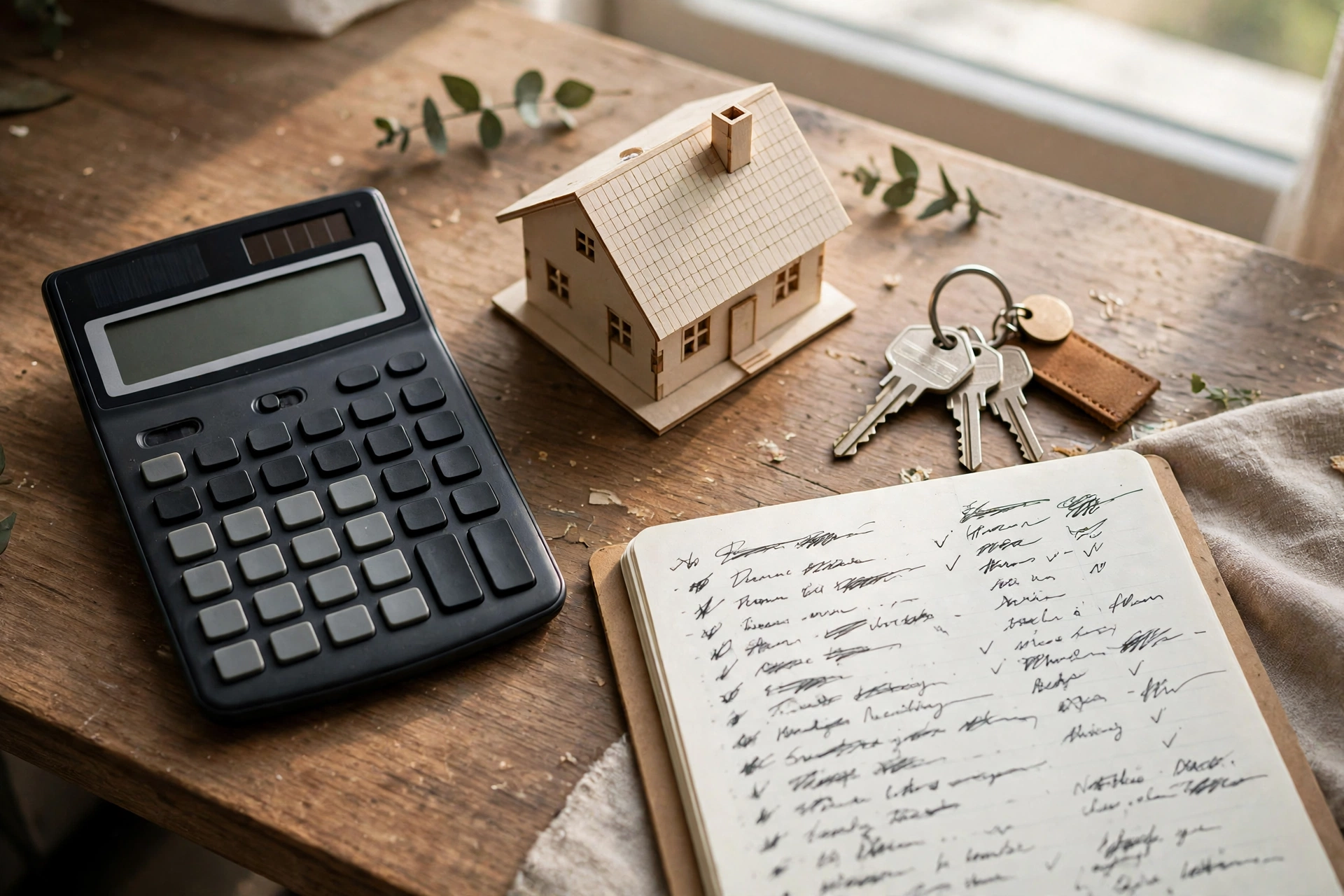
This is the part where you stop guessing. SavyTools’ Mortgage Calculator is free, runs in your browser, and needs no signup. It estimates your monthly principal and interest payment, your loan amount, your total interest, and the total cost of the loan including your down payment. One honest limit to know upfront: it does not include property taxes, insurance, or HOA fees, so add those yourself for the full monthly picture.
- Enter the home price and your planned down payment. Start with a price you have actually seen in your area, not a dream number from another city.
- Enter the interest rate and choose your loan term. Try 30 years first, then switch to 15 years and watch how the payment jumps — and how much total interest falls.
- Read the monthly payment, then change one figure at a time. A bigger down payment, a slightly lower price, a different rate. That is how you find the version that fits.
The Costs Buyers Always Forget
The mortgage is the biggest monthly cost, but it is not the only one, and this is where budgets quietly break. Property taxes vary wildly by state and county and can add hundreds of dollars a month. Homeowners insurance is required by most lenders. HOA dues, if the neighbourhood has them, can range from modest to eye-watering. Then there is maintenance: a common rule of thumb is to budget about 1% of the home’s value per year for upkeep. On a $300,000 home, that is roughly $250 a month to set aside, even in years when nothing breaks. Add closing costs too, usually 2% to 5% of the loan amount, paid upfront.
15-Year vs 30-Year, and What If Rates Change?
A 30-year loan gives you a lower monthly payment and more flexibility, which is why most US buyers choose it. A 15-year loan gives you a much higher payment but far less total interest, and you own the home outright in half the time. If you are early in your career, a 30-year loan with extra payments when you can afford them can be a sensible middle path. Run both in the calculator before you decide — the total interest column has changed more minds than any advice article ever will.
Rates move the maths more than most buyers expect: a single percentage point can shift a monthly payment by hundreds of dollars. Buy a payment you can live with at today’s rate, and leave enough margin that a normal surprise — a job change, a broken furnace — does not turn your home into a burden.
Frequently Asked Questions
How much house can I afford with a $70,000 salary?
As a rough starting point, 28% of a $70,000 salary gives you about $1,633 a month for total housing costs. What house price that supports depends on your down payment, rate, taxes, and debts, so run your own numbers in a mortgage calculator rather than trusting a single price estimate.
Can I buy a house with less than 20% down?
Yes. Many buyers purchase with 3% to 10% down. Your monthly payment will be higher, and you will usually pay PMI until you build enough equity, but a smaller down payment is a normal, workable path — as long as the monthly payment still fits and you keep an emergency fund intact.
Does SavyTools’ mortgage calculator include taxes and insurance?
No — it estimates principal and interest, total interest, and total loan cost, but taxes, insurance, and HOA fees are not included. Add your local estimates for those on top of the calculator’s monthly figure to get your full housing payment.
So, how much house can you afford? Start with the payment, not the listing. Test it with the Mortgage Calculator before you fall for a kitchen, check the maths with the Percentage Calculator, and see how savings grow with the Compound Interest Calculator. The right house is not the biggest one you can buy. It is the one you can comfortably keep.